
Air conditioning cools a room. It does not clear smoke from a kitchen, dust from a workshop, damp from a basement store or stale air from a full meeting room. That is ventilation, and when it is missing people notice it as heat, smell, condensation, mould and machines that clog with dust.
Shred Designs designs, fabricates and installs ventilation, air filtration and dehumidification systems from Kamakis, Eastern Bypass, for kitchens, factories, workshops, clinics, schools, offices and homes. Ductwork is made in our Kamakis workshop, so we can fit it to your building rather than forcing your building to fit standard parts. If you also need cooling, see AC Installation and Commercial & Industrial HVAC.
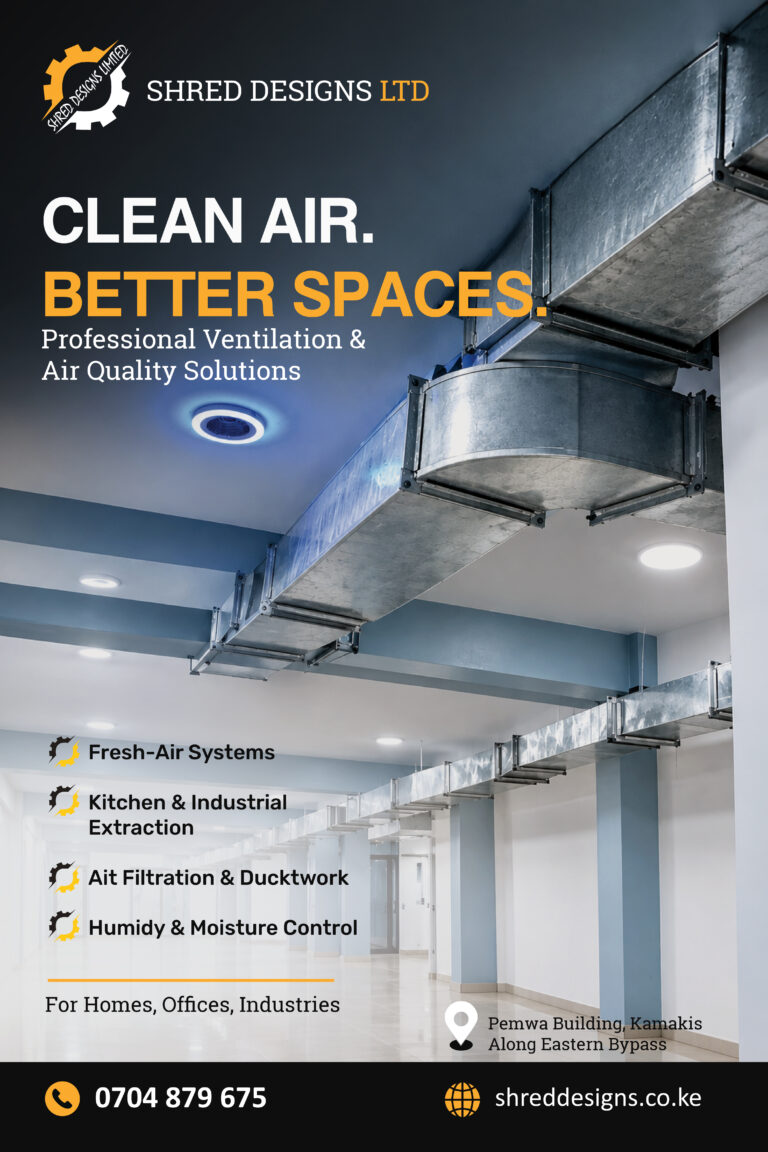
What We Install
Extractor fans and exhaust networks
Wall, roof and inline extractor fans with ducted exhaust for factories, workshops, toilets, stores and kitchens.
Commercial kitchen extraction
Extraction canopies, grease filters, ducting, fans and make-up air for restaurants, hotels, canteens and institutional kitchens.
Fresh-air and air handling units
Air handling units and fresh-air supply with filtration, ducted to the spaces that need a steady supply of outside air.
Air filtration
Coarse, fine, HEPA and activated-carbon filter stages for offices, clinics, clean manufacturing areas and odour-prone spaces.
Dehumidifiers
Refrigerant and desiccant dehumidifiers with drainage for basements, stores, archives, workshops and cold room anterooms.
Ductwork fabrication and insulation
Galvanised ducting, dampers, grilles and insulation made to your building, with supports and sealing done properly.
Problems We Solve
|
Symptom |
Usual cause |
What we do |
|
Stuffy or hot room even with the AC on |
No fresh-air supply, recirculated air with heat and carbon dioxide building up |
Add a filtered fresh-air supply and balance it with extraction |
|
Kitchen smoke or grease smell reaches the dining area |
Extractor too small or starved of make-up air, dirty filters and ducts |
Resize the canopy and fan, add make-up air, clean or replace filters, re-route ducting |
|
Condensation on walls and windows, black mould |
Humid air trapped with no extraction, cold surfaces |
Extract at wet areas, add a dehumidifier, improve air movement |
|
Dust on machines, stock or products |
Poor filtration, unsealed openings, no controlled air supply |
Filtered supply air, local dust extraction and upgraded filters |
|
Damp smell in stores, basements or archives |
Low air movement and high humidity |
Dehumidifier with drain, plus mechanical ventilation |
|
Heat and fumes from workshop processes |
No local exhaust at the source |
Local extraction hoods and roof extractors |
|
Smelly toilets and washrooms |
Weak or missing extract, ducts not reaching outside |
Inline extractors ducted to outside |
How Much Ventilation Does a Space Need?
Ventilation is sized by air changes per hour (ACH): how many times the room’s air is replaced in an hour. Typical design ranges are below. They are a starting point only, because heat, fumes and occupancy change the answer.
|
Space |
Typical ACH |
Notes |
|
Offices and meeting rooms |
4–8 |
Higher where crowded |
|
Restaurants and dining areas |
8–12 |
Higher with smoking or high occupancy |
|
Commercial kitchens |
15–30 |
Depends on canopy size and cooking equipment |
|
Workshops and light industrial |
6–20 |
Driven by heat and fume sources |
|
Toilets and washrooms |
8–15 |
Continuous extract to outside |
Choosing the Right Filter
|
Filter stage |
What it captures |
Typical use |
|
Coarse (G4) |
Larger dust, lint and insects |
First stage, protects coils and fans |
|
Fine (F7–F9) |
Fine dust, pollen and some smoke |
Offices, clinics, clean manufacturing |
|
HEPA (H13–H14) |
Very fine particles and airborne bacteria |
Laboratories, theatres, clean rooms |
|
Activated carbon |
Odours and some gases |
Kitchens, waste rooms, laboratories |
Dehumidification
Indoor humidity of about 40–60% is comfortable and keeps mould down. Above that, damp stores, basement offices and archives start to smell, and stock and paper suffer. Refrigerant dehumidifiers work well in warm, humid spaces. Desiccant units suit cooler spaces and low-humidity targets. We size by moisture load and make sure the unit has a proper drain.
Our Process
- Survey and measurement. We measure the space, note the heat, smoke, dust or damp sources, and record how it is used.
- Airflow design. We size fans, ducts and filters from the required air changes and the pressure the system must overcome.
- Ductwork, hoods and fittings are made in our Kamakis workshop to the building’s dimensions.
- Fans, ducts, dampers and filters are installed, supported and sealed, with electrical supply and controls.
- Balancing and testing. We measure airflow at the points that matter and adjust dampers until the design is met.
- Handover and filter schedule. You receive a filter-change schedule and a record of the settings, and can take a service plan.
Who We Serve
Restaurants, hotels and canteens; factories and workshops in Tatu City and Thika; clinics and schools; offices with basement or windowless spaces; and stores holding stock that is sensitive to damp or dust. Our Mechanical Engineering & Fabrication team can also build supports, platforms and steel work around the equipment, and we supply fans and filters through Industrial & Technical Supplies.
|
Shred Designs tip If kitchen smoke drifts back into the dining area even with the extractor running, the cause is often missing make-up air. A powerful extractor cannot pull air out of a room that is not letting air in. |
Related services
- Commercial & Industrial HVAC
- AC Installation
- HVAC Maintenance Contracts
- Mechanical Engineering & Fabrication
- Industrial & Technical Supplies
- All HVAC Installation & Repair services
Frequently Asked Questions
Do I need ventilation if I already have air conditioning?
Yes. A standard split AC recirculates room air and does not bring in fresh air. In crowded rooms, kitchens and sealed spaces, air quality drops even while the room feels cool.
How many extractor fans does my kitchen need?
It depends on the cooking equipment, canopy size and ceiling height. We size by air volume and make sure make-up air is provided, rather than counting fans.
Do you fabricate ductwork?
Yes. We make ducting, hoods and fittings in our Kamakis workshop, in galvanised steel or to your specification.
What filter class do I need?
Coarse filters protect equipment, fine filters suit offices and clinics, and HEPA is for clean rooms, theatres and laboratories. We recommend by use, not by the highest number.
Will a dehumidifier stop mould?
It helps a lot when humidity is the cause, but mould also needs the damp source fixed, such as leaks and poor drainage. We check both.
How often should filters be changed?
It depends on the dust load. Coarse filters in a dusty workshop may need checking monthly, while fine filters in an office may last several months. We set a schedule at handover.
|
Request a ventilation survey Tell us what the space is used for and what the problem is, and we will arrange a visit. Request a quote | Call 0704 879 675 | info@shreddesigns.co.ke Shred Designs Limited, Pemwa Building, Kamakis, along Eastern Bypass |

Contact Detail
- Pemwa Building, Eastern Bypass, kamakis
- info@shreddesigns.co.ke
- (254) 704-879-675