
A good air conditioner installed badly is a bad air conditioner. Wrong capacity, a long or kinked copper pipe run, no vacuum, a drain with no fall, an undersized cable: each one shortens the life of the unit or raises your power bill, and none of them shows on the day it is switched on.
Shred Designs supplies and installs split, cassette, ducted and multi-split systems for homes, offices, shops, clinics and light industrial units from our base on Eastern Bypass, Kamakis. We survey the space, size the unit from the actual heat load, install to the manufacturer’s specification and commission the system with recorded readings before we hand it over. For multi-floor buildings and larger plant, see Commercial & Industrial HVAC.
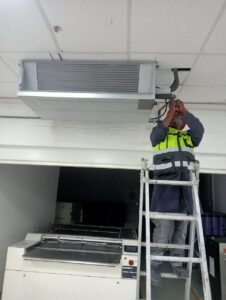
What We Install
Wall-mounted split AC
Inverter and non-inverter split units for bedrooms, living rooms, offices and shops, positioned for airflow and service access.
Ceiling cassette units
Four-way cassette units for open-plan offices, showrooms, restaurants and churches, fitted flush into the ceiling with a condensate pump where needed.
Floor-standing and ceiling-suspended units
Floor-standing and under-ceiling units for halls, classrooms, clinics and spaces where wall or cassette mounting is not practical.
Ducted and concealed split systems
Concealed ducted units with supply and return grilles for homes and offices that need cooling without visible indoor units.
Multi-split systems
One outdoor unit serving two to five indoor units, suited to apartments and small offices with limited space for outdoor equipment.
Relocation and replacement
Refrigerant recovery, removal and re-installation of existing units when you move premises, renovate or upgrade to an inverter model.
Supply of units
Supply of split and ducted units in the capacity your site needs, or installation of units you have already bought after we check their capacity.
Electrical and drainage works
Dedicated circuits, breakers, isolators and earthing for the unit, plus condensate drain lines and pumps laid with the correct fall.
Getting the Size Right
Capacity is the most common installation mistake. A unit that is too small runs flat out and never reaches the set temperature. One that is too large cools the air quickly but switches off before it removes humidity, so the room feels cold and clammy. As a first guide only:
Unit capacity | Approx. cooling (BTU/h) | Typical room area |
0.75 ton | 9,000 | Up to about 15 m² |
1 ton | 12,000 | About 15–22 m² |
1.5 ton | 18,000 | About 22–35 m² |
2 ton | 24,000 | About 35–50 m² |
3 ton | 36,000 | About 50–70 m² |
These figures assume an ordinary room with a standard ceiling height and average sun. Top-floor rooms under iron sheet or concrete roofs, west-facing glass, high ceilings, kitchens, server equipment and crowded rooms all raise the load. Our survey measures them, and the heat-load check decides the final capacity.
Which Type Suits Your Space
Type | Best for | Keep in mind |
Wall split | Bedrooms, small offices, shops | Needs a wall with outdoor-unit access within the model’s pipe-length limit |
Ceiling cassette | Open-plan offices, showrooms, restaurants | Needs a ceiling void and a drain route |
Ducted or concealed | Whole-floor homes, offices that want no visible indoor units | Needs ceiling space and proper duct design; usually the most costly to install |
Multi-split | Apartments and small offices with limited outdoor space | One outdoor unit serves all rooms, so a fault there affects every room |
Floor-standing or suspended | Halls, classrooms, clinics | Needs floor or under-ceiling space clear of obstruction |
Our Installation Process
- Site survey and heat-load check. We measure the room, note sun exposure, roof type, occupancy and equipment, and agree the capacity and unit positions with you.
- Written quote. An itemised quote lists the unit, included pipe length, electrical works, brackets, drain, commissioning and warranty, so you can compare like with like.
- The indoor unit goes on a level bracket fixed to a sound wall and the outdoor unit on a pad or wall brackets, with clearance for airflow and service access.
- Copper pipework. Insulated copper lines follow the shortest practical route with neat bends and joints made to the manufacturer’s practice, brazed under nitrogen flow where the model requires it.
- Nitrogen pressure test. The lines are pressurised with nitrogen and held, so leaks show up before any refrigerant goes in.
- A vacuum pump removes air and moisture from the pipework and indoor unit until the reading is stable, because moisture in a refrigerant circuit damages the compressor.
- Electrical connection. A dedicated circuit with the correct breaker, cable size, isolator and earthing, with voltage protection recommended for inverter models.
- The condensate drain is laid with a continuous fall and tested with water so nothing drips onto walls, ceilings or people.
- We run the system and record air temperatures, pressures and running current, then confirm the unit cools, drains and shuts off correctly.
- We show you the remote controls, filter cleaning and basic care, and give you the warranty details and our contact for servicing.
What a Good Installation Quote Includes
- Brand, model and capacity of each unit, and whether it is inverter or fixed-speed
- The pipe length included and the rate per metre beyond it
- Electrical works: cable, breaker, isolator and any distribution board changes
- Brackets, outdoor pad or stand, and any scaffolding or access equipment
- Drain line, condensate pump if needed, and making good of wall or ceiling openings
- Commissioning and testing, and the warranty terms for parts and workmanship
- Programme: when we can start and how long the work takes
What Affects the Price
We do not publish a flat price because two installations of the same unit can differ by more than the unit itself. The main drivers are:
- Unit capacity and type, and whether it is inverter or fixed-speed
- Length of the pipe run between the indoor and outdoor units
- Wall or ceiling construction, and the height the work is done at
- Electrical upgrades, such as a new circuit or breaker
- Concealed pipework compared with exposed pipework
- The number of units installed in one visit
Send us photos and the room size, or book a survey, and you will get an itemised written quote. Once the system is in, our AC repair and servicing team keeps it running, and businesses with several units can use an HVAC maintenance contract.
Power, Protection and Refrigerants
Voltage swings and outages are a fact of grid supply in Kenya, and inverter compressors and control boards are the parts most exposed to them. We fit the right breaker and recommend a voltage protector where your supply needs one. Modern split units use R32 or R410A. R32 is mildly flammable, so it is handled to the manufacturer’s procedure, which is another reason to use trained installers.
Who We Install For
Homes and gated estates in Membley, Toll, Red Soil and Riverside; shops, offices and clinics in Ruiru, Kimbo and Kamakis; and offices, control rooms and canteens in Tatu City. If your building needs zoned or multi-floor cooling, or you have ventilation and fresh-air needs alongside cooling, see Commercial & Industrial HVAC and Ventilation & Air Quality.
Shred Designs tip Call before you buy the unit. Capacity and pipe-length limits are listed on every model’s spec sheet. If you send us the room size, photos and the spot where the outdoor unit could go, we can confirm the right model before you pay for the wrong one. |
Related services
- AC Repair & Servicing
- Commercial & Industrial HVAC
- Ventilation & Air Quality
- HVAC Maintenance Contracts
- Car AC Repair (vehicle air conditioning)
- All HVAC Installation & Repair services
- HVAC Installation Kamakis: Your Complete Guide to Getting It Right
Frequently Asked Questions
How long does installing a split AC take?
A single standard wall split with a short pipe run is usually finished in half a day. Cassette, ducted and multi-split systems, long pipe runs and concealed pipework take longer, and we give you a time estimate in the quote.
Can you install an AC I bought elsewhere?
Yes. We check that the capacity suits the room and the pipe length is within the model’s limits, then install it. The warranty on the unit itself stays with the seller or manufacturer.
Is an inverter AC worth it?
For rooms used many hours a day, usually yes. The compressor adjusts its speed instead of switching on and off, which cuts running cost and temperature swings. For a spare room used a few hours a week, a fixed-speed unit can make more sense.
How far apart can the indoor and outdoor units be?
Every model has its own maximum pipe length and height difference, published in its installation manual. We check the limit for your unit before we quote.
Do I need a separate breaker for my AC?
Yes. Each AC should have its own correctly rated breaker and cable. Sharing a circuit with sockets or other loads causes tripping and overheating.
Do you install in Tatu City, Juja and Thika?
Yes. Our base on Eastern Bypass puts Tatu City and Ruiru within easy reach, and we also install along the Thika Road corridor including Juja, Kahawa Sukari and Thika.
Book an AC installation survey Send the room size and a photo of the wall or ceiling, or ask for a site visit. Request a quote | Call 0704 879 675 | info@shreddesigns.co.ke Shred Designs Limited, Pemwa Building, Kamakis, along Eastern Bypass |